
The True Cost of Choosing the Wrong Tenant: Why Proper Screening Protects Your Rental Investment
All County® Property Management | National Blog | Property Owners & Real Estate Investors
A rental property can be one of the smartest investments you make. However, one poor tenant placement can quickly turn a profitable investment into a financial nightmare.
Many property owners focus on finding a tenant as quickly as possible. After all, every day a property sits vacant represents lost rental income. But what happens when the rush to fill a vacancy results in accepting an applicant without properly verifying their qualifications?
The consequences can be far more expensive than an additional few weeks of vacancy.
The true cost of choosing the wrong tenant goes well beyond one missed rent payment. Unpaid rent, property damage, legal expenses, eviction proceedings, turnover costs, and extended vacancies can add up to thousands of dollars.
At All County® Property Management, we believe that protecting your rental investment begins long before a resident receives the keys. It starts with a thorough, consistent, and legally compliant tenant screening process.
1. Unpaid Rent: The First Financial Warning Sign
One of the most immediate risks of inadequate tenant screening is unpaid rent.
Imagine owning a rental property that generates $2,000 per month. Your resident stops paying, but your financial obligations continue.
You still have to cover the mortgage, property taxes, insurance, HOA fees, and necessary maintenance. Meanwhile, the property isn’t producing the income you expected.
Consider the financial impact:
| Missed Rent | Lost Rental Income |
|---|---|
| 1 month | $2,000 |
| 2 months | $4,000 |
| 3 months | $6,000 |
| 4 months | $8,000 |
And these figures don’t include legal expenses, damage, or the cost of finding another resident.
A few missed payments can erase a substantial portion of your annual rental profits.
This is why verifying income, evaluating credit history, and reviewing relevant rental payment history are important steps in the tenant screening process.
2. Property Damage Can Destroy Your Profit Margins
Normal wear and tear is an expected part of rental ownership. However, significant damage beyond ordinary use can create costly problems.
Imagine discovering that a resident has left behind:
- Damaged flooring and interior doors
- Large holes in walls
- Broken fixtures or appliances
- Unauthorized alterations
- Excessive trash and debris
- Damage caused by unreported maintenance problems
A property that should have required a simple cleaning and minor touch-ups could instead need thousands of dollars in repairs.
Even when a security deposit is available, it may not cover the full cost of damage and unpaid obligations.
Worse, repairs can delay the property’s return to the rental market, creating additional lost income.
The financial loss is not just the cost of fixing the property. It’s also the rent you cannot collect while those repairs are being completed.
3. Evictions: A Costly and Time-Consuming Process
When a resident fails to meet their lease obligations, property owners may eventually need to pursue legal remedies, including eviction.
The eviction process varies by state and locality, but it may involve legal notices, filing fees, attorney expenses, court proceedings, and enforcement costs.
And while the process moves forward, unpaid rent may continue to accumulate.
Owners can also experience stress and disruption from managing the situation.
Proper screening cannot guarantee that an eviction will never become necessary. Even previously reliable residents can experience unexpected financial difficulties.
However, evaluating relevant financial qualifications and rental history before approving an applicant can help identify avoidable risks.
4. The Hidden Cost of Starting Over
When a problematic tenancy finally ends, the financial consequences may continue.
The owner must prepare the property for its next resident, potentially covering cleaning, repairs, marketing, leasing expenses, and another vacancy period.
As we explain in our related article, The Hidden Cost of a Vacant Rental: Why Every Day Matters, an empty property continues generating expenses even when it produces no rental income.
Consider a property that takes another 30 days to repair and rent.
At $2,000 per month, that represents another $2,000 in lost rental income.
Combine that with unpaid rent and unexpected repairs, and the financial impact becomes significant.
5. What One Poor Tenant Placement Could Actually Cost
Let’s put everything together using a hypothetical example.
An owner rents a property for $2,000 per month. The resident subsequently stops paying, the tenancy ends after several months, and the property requires repairs before it can be rented again.
ILLUSTRATIVE FINANCIAL IMPACT
$13,700
Potential gross loss from a single problematic tenancy
| Three months of unpaid rent | $6,000 |
| Legal and eviction expenses | $1,500 |
| Excess property damage and cleaning | $3,500 |
| One month of additional vacancy | $2,000 |
| Marketing and re-leasing expenses | $700 |
| Total potential cost | $13,700 |
Hypothetical figures for illustration, not national averages. Actual costs vary. This example assumes no recoveries, reimbursements, or security deposit offsets and avoids including routine ownership expenses already incurred.
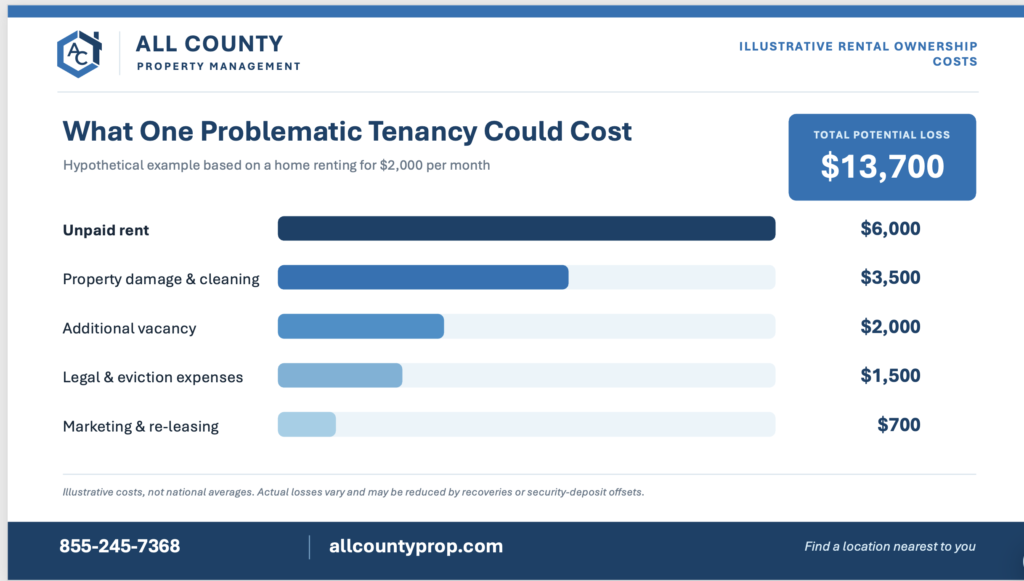
That represents almost seven months of gross rental income on a $2,000-per-month property.
A single unfortunate tenancy can wipe out much of the income an investor expected to earn that year.
Of course, not every screening mistake results in this level of loss, and thorough screening cannot eliminate every risk. But the example illustrates why tenant selection deserves the same attention as property acquisition, financing, and maintenance.
6. Why Cutting Corners on Tenant Screening Is a Risky Gamble
Sometimes owners are tempted to approve an applicant simply because the property has been sitting vacant.
They may hear statements such as:
- “I just started a new job, but I make plenty of money.”
- “My previous landlord and I had a misunderstanding.”
- “I can pay several months upfront.”
- “My credit isn’t great, but I promise I’ll always pay on time.”
Any of these explanations may be legitimate. They should not automatically disqualify an applicant.
However, they also shouldn’t replace appropriate documentation and verification.
Rather than relying on promises, assumptions, personal impressions, or an applicant’s story alone, owners should evaluate reliable information under consistent, lawful qualification standards.
The objective is not to find a “perfect” tenant. It is to make a fair, informed rental decision based on relevant qualifications.
7. What a Thorough Tenant Screening Process Should Include
A responsible screening program should evaluate appropriate information related to an applicant’s ability and likelihood to meet the lease obligations.
Income and employment verification. Confirm income using reliable documentation and evaluate it against the property’s established qualification standards.
Credit and payment history. Review relevant financial history to better understand payment patterns and existing obligations.
Rental history verification. Contact appropriate prior housing providers or use reliable records to verify relevant lease performance, payment history, and documented obligations.
Background screening. Evaluate legally permissible background information carefully, taking account of accuracy, relevance, recency, and applicable federal, state, and local restrictions.
Identity and document verification. Use appropriate methods to identify discrepancies or potentially altered documents.
Consistent qualification standards. Apply lawful, objective criteria consistently while considering applicable requirements for reasonable accommodations and individualized assessments.
The Federal Trade Commission explains the responsibilities of property owners who use consumer reports in its guide, Using Consumer Reports: What Landlords Need to Know. Federal Trade Commission+1
Equally important, screening reports are not infallible. Errors, outdated information, and mismatched records can harm qualified applicants. Owners and property managers must use appropriate procedures and comply with applicable consumer reporting laws.
8. Fair Housing Compliance Is Just as Important as Financial Protection
Tenant screening is about evaluating relevant qualifications—not judging applicants based on personal characteristics or assumptions.
The federal Fair Housing Act protects individuals against housing discrimination based on race, color, religion, sex, national origin, familial status, and disability. State and local laws may provide additional protections.
The U.S. Department of Housing and Urban Development provides detailed guidance on screening rental applicants fairly.
A screening process that relies on overly broad exclusions, inaccurate records, or inconsistent decisions can create legal and financial exposure of its own. Additionally, when consumer report information contributes to an unfavorable rental decision, the Fair Credit Reporting Act may require an adverse action notice. |+1
Protecting your rental property and treating applicants fairly are not competing priorities. A well-designed screening process should accomplish both.
9. Why Professional Property Management Makes a Difference
Selecting a resident is one of the most consequential decisions a rental property owner makes.
While no property manager can guarantee that a resident will always pay rent on time or maintain a property perfectly, professional management can help owners reduce avoidable risk.
At All County® Property Management, our approach emphasizes established procedures, informed rental decisions, responsible property oversight, and clear communication with property owners.
Professional management can help with:
- Organized application processing and screening coordination
- Consistent, legally compliant qualification standards
- Lease preparation and execution
- Rent collection and delinquency follow-up
- Maintenance coordination and property oversight
- Documentation and communication
- Turnover preparation and re-leasing
Our article, The Hidden Costs of Self-Managing Rental Properties, explores why professional oversight can offer value beyond simply collecting rent.
For rental property investors, the goal isn’t merely to fill a vacancy. It’s to establish a sustainable, well-managed tenancy that supports long-term investment performance.
10. Sometimes Waiting for a Qualified Applicant Is the Smarter Financial Decision
Every property owner wants their rental filled quickly.
But there’s an important difference between minimizing vacancy and rushing the rental process.
Suppose your property rents for $2,000 per month. An additional seven days of vacancy represents approximately $467 in potential rental income.
That loss matters.
However, when compared with the possibility of thousands of dollars in unpaid rent, legal expenses, or property damage, a short delay to complete proper screening may be a reasonable investment in risk reduction.
That doesn’t mean owners should leave properties vacant unnecessarily or reject applicants based on speculation.
It means that rental decisions should be timely, objective, well-documented, and grounded in established qualification criteria.
The Bottom Line: Protect Your Investment Before Handing Over the Keys
The true cost of choosing the wrong tenant isn’t measured only in unpaid rent.
It’s measured in lost income, unexpected expenses, legal complications, property damage, additional vacancy, and the time required to resolve the situation.
A rental property is a business investment, and tenant selection is one of its most important operating decisions.
At All County® Property Management, we understand that the goal is more than collecting rent this month. It’s helping owners preserve their property, manage risk, protect their income, and build long-term financial success.
Because a vacant property costs money—but an avoidable tenant placement mistake can cost considerably more.
Protect Your Rental Investment With All County® Property Management
Before you hand over the keys, make sure your rental property is supported by a professional management process.
Whether you own one rental home or an expanding portfolio, All County® Property Management can help you navigate leasing, resident screening, maintenance, rent collection, and the everyday challenges of rental ownership.
Owning Rental Properties Just Got Easier.™
All County® Property Management
Find a location nearest to you.
855-245-7368
allcountyprop.com — Find Your Local OfficeAll County offices are independently owned and operated.
Frequently Asked Questions
How much can choosing the wrong tenant cost a landlord?
Costs depend on the circumstances, but unpaid rent, legal proceedings, repairs, and vacancy can produce losses of thousands of dollars. The hypothetical example above illustrates a potential $13,700 gross financial impact.
Can tenant screening prevent eviction?
No screening process can guarantee future performance. However, lawful income verification, relevant rental history, credit analysis, and other appropriate screening steps can help identify certain risks before a lease is signed.
Key Takeaways
- Choosing the wrong tenant can lead to significant financial losses, such as unpaid rent and property damage.
- A thorough tenant screening process can help avoid these costly pitfalls by verifying income, credit history, and past rental behavior.
- Evictions not only incur legal costs but can also result in lost rent; proper screening minimizes these risks.
- Hidden costs, like turnover and repairs, can add up, highlighting the importance of careful tenant selection.
- Investing time in proper tenant screening ultimately protects your rental investment from unexpected expenses.
Estimated reading time: 10 minutes
What is the most important part of tenant screening?
There isn’t one universal factor. Evaluating relevant information consistently and accurately, using lawful qualification standards, is generally more dependable than relying on a single score or personal impression.
Should a landlord accept the first applicant?
An owner should follow their established, lawful application and selection procedures. An applicant should not be approved merely because they applied first, nor rejected without a legitimate basis under those procedures.
Is hiring a property management company worth it?
Professional property management can be valuable for owners who want structured screening, leasing, collections, maintenance coordination, and help navigating everyday management responsibilities. Results and costs vary by property and local market.